 |
| The seafront takes a battering |
So last weekend, Storm Angus swept its way through the UK bringing a first real taste of Autumn storms and rain.
I'm confined to barracks at the moment, so hadn't planned any outings. Time to curl up with books, magazines and some homely fare.
And where better to start than somewhere that is as used to wind and rain on an August afternoon as on a November night- Wales!
My first set of recipes have a Welsh theme- and why not? Welsh produce is top notch, and reminds me in many ways of the cuisine of my beloved Auvergne.
I'm starting by making a
Welsh Rarebit Paste- not for spreading on toast ( although that is of course delicious) but for topping lasagne and fish.
You will need:
2 tbsp butter
2 tbsp plain flour
200g grated sharp cheddar
splash of milk
splash of beer (optional but worth it)
dash of Worcestershire sauce
1 tsp mustard
1. Melt the butter in a non-stick pan and shoot in the flour
2. Cook over a low heat until it forms a ball in the pan
 |
| Cook together the butter and the flour |
3. Add the rest of the ingredients, and cook through until the cheese has melted and the mixture leaves the side of the pan as a thick sauce.
4. Taste and adjust seasoning then leave to cool.
You can store this paste in the fridge for a few days, to make a variety of dishes.
The first one I am making is Lasagne Llsiau- Welsh veggie lasagne.
You need 3 sauces for this dish: your rarebit topping, a tomato and veggie one and a cheese and veggie one.
Ingredients:
(for the cheese and veg sauce)
2 tbsp butter
2 tbsp flour
350 ml milk
150g crumbled Caerphilly cheese or Tomme
150g chopped kale or spinach or chard
1 chopped leek
(For the tomato sauce)
1 chopped onion
1-2 crushed cloves of garlic
150g sliced mushrooms
1 x400g tin chopped tomatoes
10-12 lasagne sheets
1. Steam the kale and leeks over simmering water.
 |
| Greens a-steaming |
3. Make the tomato sauce by frying the onion, garlic and mushrooms, any other 'fridge veg' you have in the veg drawer eg. aubergines, courgettes etc and adding the tinned tomatoes. Simmer for 10 minutes. Season to taste.
4. Make a bechamel sauce, in the same way as the rarebit but adding more milk and the crumbled Caerphilly.
 |
| Bechamel sauce |
Fold in the steamed leeks and kale.
 |
| Add your steamed greens |
5. Now assemble your lasagne- layers of tomato sauce, kale sauce and lasagne sheets alternatively.
6. Using a wet palette knife, spread the rarebit over the top, covering the pasta completely.
 |
| Spread on the rarebit |
7. Bake at 180 degrees for 20-30 minutes until brown and bubbling.
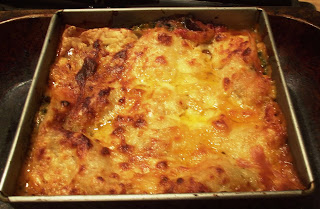 |
Welsh rarebit topped Lasagne Llsiau
|
If you have leftover rarebit paste, spread it on top of some lightly poached smoked haddock and grill until brown and bubbling.
 |
| Rarebit topped smoked haddock |
Or make a croque-monsieur. Just make a cheese and ham toastie, the way you normally would (in a sandwich toaster or in the frying pan), then top the lot with some rarebit paste, grill and off you go!
 |
| Croque-monsieur |
If you have leftover kale or greens from the lasagne, try making this simple Italian dish-
Gnocchi alla Toscana. I chucked everything in the slow cooker, but it would work equally well on the stove or in the oven.
To serve 4 hearty portions:
Ingredients:
500g fresh gnocchi
400g Italian sausages
200g chopped fresh kale/greens
1 x 400g tin cannelini beans
2 x 400g tins chopped tomatoes
1 large onion chopped
2-3 cloves of garlic (crushed)
1/2 tsp chilli flakes or finely chopped red chilli
generous pinch each of salt, black pepper and sugar
1 glass red wine
2 bay leaves
2 tsp oregano
1. Fry the onion until translucent, add the garlic and chilli and cook for a further minute.
2. Place the onion/garlic/chilli in a crockpot or casserole and add the two tins of chopped tomatoes, the oregano and bay leaves and the red wine
3. Slip the sausages out of their skins and, with wet hands, shape the meat into little pellets ( the size of a Malteser)
4. Brown these lightly until the fat starts to run, drain them on kitchen paper and add to the casserole
 |
| Fry off the little sausage meatballs |
5. Cook for 3-4 hours in a slow cooker, 1-2 hours in a casserole dish in the oven (at 160 degrees) or on the stove.
6. Half an hour before serving, add the cannelini beans ( and some of their water from the tin if the mixture seems dry), the chopped kale and adjust the seasoning with salt, pepper and sugar. Stir until all the kale is in the liquid.
7. Meanwhile cook the gnocchi in boiling water for 2 minutes and then drain and add to the casserole.
8. Serve with grated Parmesan (if you like it.)
 |
| Gnocchi Alla Tuscana |
.
If you have leftover gnocchi- coat the dumplings in a bechamel sauce ( as above), pour into a gratin dish, top with some grated Parmesan or nutmeg (depending on your preference) and grill until browned.
 |
| Gnocchi Gratin |
Makes an excellent side dish.
And finally, how about a comforting pud?
I'm grateful to H F-W for this one, as it comes from his book 'Love your Leftovers.'
This pud tasted both light and satisfying- and used up humble imgredients- breadcrumbs, eggs, marmalade and a splash of booze. You could make it with jam and crème de cassis, or tropical fruit and Malibu, raisins and rum, or any combination of fruit and booze you fancy.
Marmalade Pud
half a jar of marmalade (mixed with some hot water to loosen it and then cooled)
2 eggs (separated)
200ml cream
100g sugar
1 teaspoon Grand Marnier or Cointreau
150 g soft white breadcrumbs ( from stale bread)
1. Grease a pudding dish and put the oven on to warm at 180 degrees.
2. Mix the marmalade, egg yolks, cream, sugar and booze.
3. Keeping back a handful of breadcrumbs for the topping, shoot in the breadcrumbs and mix thoroughly.
4. Whip the egg whites until firm and then, using a metal spoon, carefully fold them into the marmalade mixture as if making a soufflé.
 |
| Egg whites at 'stiff peak' stage |
5. Pour the fluffy mixture into your pudding dish, sprinkle the remaining breadcrumbs on top
 |
| Souffléd mixture ready for the oven |
Stand this in a baking tin half filled with hot water, and bake for 50-60 minutes until golden and still a bit wobbly.
 |
| And ready to come out... |
6. Serve with ice cream.
 |
| Souffléd Marmalade Pud |
And so, with tummies full, is it time to think about hibernating for the winter?
 |
| See you in the Spring! |