Tuesday, 21 February 2017

Tipsy Lady Marmalade


Seville oranges are in season (less than 2 euros per kilo in the market) and the weather is uninspiring and grey outside- so, a good time to get out the preserving pan again and brighten things up with some home made marmalade.

I am actually a novice marmalade maker- so this was a bit of an adventure.
I looked for an easy recipe- and here it is:


Easy Marmalade
Makes 2.5 kilos


7 Seville oranges (scrubbed)
2 sweet oranges (scrubbed)
1 lemon (scrubbed)
1.3 kilos sugar

1. Put the whole fruits and 1.7 litres of water into a large pan and simmer for an hour until soft.


Boiled and softened fruit
2. Allow to cool (preferably overnight), then take out the fruit and cut it in half. Squeeze out the juice and put it back into the pan and pick out the pips.
3. Put these into a square of muslin and tie with string.

Pips all bundled up
4. Put the peel and flesh into a food processor and pulse coarsely
5. Make the liquid in the pan back up to 1.4 litres
6. Dissolve the sugar slowly in the cooking liquid and add the bag of pips, tied to the side of the pan.
7. Stir in the chopped fruit and bring up to a rolling boil.
8. Boil for 25-30 minutes until the marmalade reaches setting point (105 degrees) or when a spoonful of it placed on a cold saucer wrinkles and 'sets'.

I was lucky enough to be given a jam thermometer at Christmas- which took a lot of the guesswork out of reaching setting point. However, I read that adding two tablespoons of whisky to the cooled marmalade will help with a stubborn set- and enhance the flavour somewhat too!

Ready to set and go!

Talking of whisky, I don't really drink the stuff (except on Burns Night of course)- but it can add a certain je ne sais quoi to various dishes. I use it to bring my Scottish Shortbread together and it adds a lovely smooth, toffee-like flavour to the biscuits:

Whisky Shortbread
Whisky Shortbread

The best shortbread is made with a ratio of 3:2:1 (eg. 300g flour, 200g butter, 100g sugar). I like to replace 1 tbsp of the flour with cornflour to lighten it a little.
Just put all the ingredients in a food processor and pulse until fine. Add two caps of whisky and pulse until it comes together in a soft dough.
Turn out into a greased baking tin, press evenly to fill the space and bake at 150 degrees for 15 minutes or so until lightly golden. (Keep an eye on it, as you don't want it to overcook).
Once out of the oven, prick with a fork all over and mark into slices.

Sprinkle with vanilla sugar et voila!

I am looking forward to tasting my marmalade with fresh French bread or croissants- but it will go well in either of these dishes too. (Better still, if you want to use up leftover shop bought stuff before luxuriating in your homemade preserve.)

Sticky Marmalade Cake:


Souffled Marmalade Pud:


http://lizsleftovers.blogspot.fr/search/label/marmalade

Cookery Club was interesting this week too, from a fruity point of view. We made 'Pommes au Four au Porto' (Baked Apples in Port Wine). Thanks to Michelle for the recipe and demonstration.

Les Pommes Au Porto de Michelle

Ingredients: (for 4)

4 dessert apples
4 dessertspoons raisins blonds or sultanas
15g butter
4 tsp golden caster sugar
white port or dry sherry

1. The day before, soak the raisins in port
2. Wash and then hollow out the apples, but don't completely core- you don't want to go all the way through
Hollow out the apples


3. Put a knob of butter in each apple

Butter in!
4. Then a spoonful of raisins

Raisins in!
5. Pour over some more port and sprinkle on the sugar

Pour on the port generously!
6. Bake at 180 degrees for 45 minutes, basting occasionally with the syrup.

Pommes Au Porto
They look a little like I feel after all this boozy cooking!

Time for a little siesta now.

There are a few more cooking events coming up before I set sail for England again. I don't want to spoil the surprise but here is a little hint of what is to come:


Thursday, 26 January 2017

Spuds You Like


Back to village life in the Auvergne- and it's pretty busy here.
I have joined the Village Cookery Club and went to my first session last week. Goodness me, the standard was high! But the welcome was warm and I learned a lot.


Each session, a group member shares a recipe with the rest- and we all take turns in its preparation.
The main dish we made this time was 'Pommes Dauphiné'- and thus the idea was born for this month's potato- themed blog.

'Pommes Dauphiné' are not to be confused with Potatoes Dauphinoises- which everyone is familiar with. No, these tasty little morsels are deep-fried bites of choux paste and potato. Great for using up leftover mash.
They also freeze well- or can be made the day before you need them and reheated in a hot oven.
This recipe makes at least 60. (Many thanks to Joselyne for the recipe and the demonstration.)

Pommes Dauphine

Ingredients:
450g mashed potato (well seasoned and not too sloppy)
75g margarine
3 eggs
180g flour
salt, pepper and oil for frying
Begin by making a choux paste- melt the butter in the seasoned water. When the liquid starts to bubble, take off the heat,  shoot in the flour and work well with a wooden spoon until smooth.
Making the choux paste


 Add the eggs one at a time, working them in with a fork, until the mixture is smooth. Next work in your mash- plenty of elbow grease required-


and then leave the paste to firm up (in the fridge for a few hours or the freezer for an hour or so.) As we are in the Auvergne, and temperatures were -10 degrees, it was sufficient to put it out on the windowsill for a short while!

Heat up some sunflower oil and then drop in teaspoons of the mixture.


Fry in batches


Take care not to crowd the pan too much- lift out the potato balls as soon as they are golden and drain on kitchen paper as you fry in batches.

Fry until golden


This week gives us Burns Night too- and we celebrated with our Neeps and a Haggis Parmentier.


                          .
http://lizsleftovers.blogspot.fr/2015/01/haggis-parmentier-burns-supper-french.html

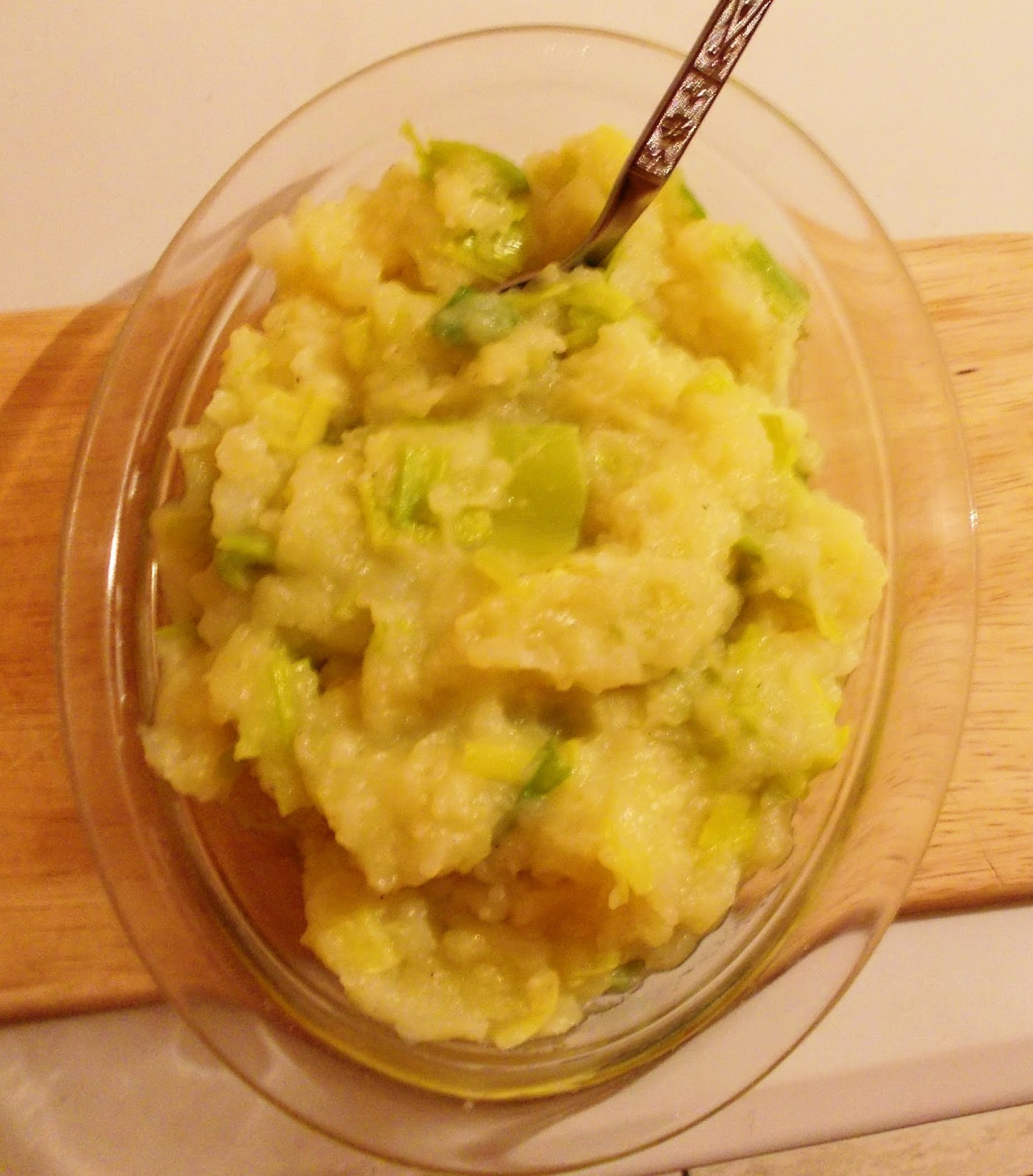
I varied the potato topping this year however by adding leeks to make a 'Champ'.
Usually, this potato puree is mixed with spring onions- but I am using leeks as they are in season here.
To make Champ, heat some butter in a saucepan, and add 1 shredded leek. Reduce the heat, add a dash of water and some seasoning and cover with a butter wrapper or piece of cooking paper. Put on the lid of the saucepan and simmer the veg until tender. Drain off any excess water, add 200g per person of cooked potato and some milk and heat. When beginning to bubble, take off the heat and mash the potatoes, incorporating them well with the leeks.


Champ with Leeks
Adjust seasoning, pile on top of your haggis and cook in the oven at 170 degrees, topped with a little cheese if you wish until brown and bubbling.

Another recipe I have gleaned in the short time I have been back is Potato Cocotte.

Potato Cocotte

Peel 1 kg of potatoes and cut into chunks. Slice half a dozen of the pieces with a sharp knife and slide a bay leaf into the slit.


Add a bay leaf
Preheat the oven to 180 degrees.
Chop and fry 1 onion and 300g of bacon lardons until the onion is transparent, add the potatoes and turn them well to absorb the cooking butter.
Place in an ovenproof dish with salt, pepper, nutmeg and some fresh thyme.
Pour over 300ml of hot chicken or vegetable stock.
Cover tightly and cook in the oven for about an hour, stirring halfway through the cooking time.
Dot with butter before serving.

This dish reminds me of Truffade- a traditional Auvergne dish of potato, cheese and bacon.

http://lizsleftovers.blogspot.fr/search/label/truffade

No truffles are involved in this recipe: it comes from the Occitane word truffa which is what the suspicious Auvergnats called potatoes when they were first brought to the region. Their gnarly, dirty appearance made everyone think they were truffles at first. They soon discovered their mistake.


Image result for wild boar
What? No truffles?


Plenty of other wasy to elevate the humble spud on ths blog by the way- try Marmite Potatoes Boulangere,
Image for Marmite Potatoes Boulangere
http://lizsleftovers.blogspot.fr/search/label/potatoes%20boulangere

Or Aligot

Image for Raclette Potatoes
https://witness.theguardian.com/assignment/543e91dee4b03829d13c1ff3/1198433
Or even good old Bubble and Squeak

http://lizsleftovers.blogspot.fr/search/label/bubble%20and%20squeak

Just click on the link below the picture to take you to the blogpost.

Image result for potato peel
Time to get peeling!


Thursday, 1 December 2016

Autumn Comfort Food

Related image
The seafront takes a battering


So last weekend, Storm Angus swept its way through the UK bringing a first real taste of Autumn storms and rain.
I'm confined to barracks at the moment, so hadn't planned any outings. Time to curl up with books, magazines and some homely fare.


And where better to start than somewhere that is as used to wind and rain on an August afternoon as on a November night- Wales!

My first set of recipes have a Welsh theme- and why not? Welsh produce is top notch, and reminds me in many ways of the cuisine of my beloved Auvergne.

I'm starting by making a Welsh Rarebit Paste- not for spreading on toast ( although that is of course delicious) but for topping lasagne and fish.
You will need:

2 tbsp butter
2 tbsp plain flour
200g grated sharp cheddar
splash of milk
splash of beer (optional but worth it)
dash of Worcestershire sauce
tsp mustard

1. Melt the butter in a non-stick pan and shoot in the flour
2. Cook over a low heat until it forms a ball in the pan  

Cook together the butter and the flour

3. Add the rest of the ingredients, and cook through until the cheese has melted and the mixture leaves the side of the pan as a thick sauce.

4. Taste and adjust seasoning then leave to cool.
You can store this paste in the fridge for a few days, to make a variety of dishes.
The first one I am making is Lasagne Llsiau- Welsh veggie lasagne.

You need 3 sauces for this dish: your rarebit topping, a tomato and veggie one and a cheese and veggie one.

Ingredients:

(for the cheese and veg sauce)

2 tbsp butter
2 tbsp flour
350 ml milk
150g crumbled Caerphilly cheese or Tomme
150g chopped kale or spinach or chard
1 chopped leek
(For the tomato sauce)
1 chopped onion
1-2 crushed cloves of garlic
150g sliced mushrooms
1 x400g tin chopped tomatoes
10-12 lasagne sheets
1. Steam the kale and leeks over simmering water.

Greens a-steaming
3. Make the tomato sauce by frying the onion, garlic and mushrooms, any other 'fridge veg' you have in the veg drawer eg. aubergines, courgettes etc and adding the tinned tomatoes. Simmer for 10 minutes. Season to taste.
4. Make a bechamel sauce, in the same way as the rarebit but adding more milk and the crumbled Caerphilly.
Bechamel sauce
Fold in the steamed leeks and kale.
Add your steamed greens
5. Now assemble your lasagne- layers of tomato sauce, kale sauce and lasagne sheets alternatively.
6. Using a wet palette knife, spread the rarebit over the top, covering the pasta completely.

Spread on the rarebit
7. Bake at 180 degrees for 20-30 minutes until brown and bubbling.

Welsh rarebit topped Lasagne Llsiau

If you have leftover rarebit paste, spread it on top of some lightly poached smoked haddock and grill until brown and bubbling.
Rarebit topped smoked haddock
Or make a croque-monsieur. Just make a cheese and ham toastie, the way you normally would (in a sandwich toaster or in the frying pan), then top the lot with some rarebit paste, grill and off you go!
Croque-monsieur
If you have leftover kale or greens from the lasagne, try making this simple Italian dish- Gnocchi alla Toscana. I chucked everything in the slow cooker, but it would work equally well on the stove or in the oven.

To serve 4 hearty portions:
Ingredients:
500g fresh gnocchi
400g Italian sausages
200g chopped fresh kale/greens
1 x 400g tin cannelini beans
2 x 400g tins chopped tomatoes
1 large onion chopped
2-3 cloves of garlic (crushed)
1/2 tsp chilli flakes or finely chopped red chilli
generous pinch each of salt, black pepper and sugar
1 glass red wine
2 bay leaves
2 tsp oregano
1. Fry the onion until translucent, add the garlic and chilli and cook for a further minute.
2. Place the onion/garlic/chilli in a crockpot or casserole and add the two tins of chopped tomatoes, the oregano and bay leaves and the red wine
3. Slip the sausages out of their skins and, with wet hands, shape the meat into little pellets ( the size of a Malteser)
4. Brown these lightly until the fat starts to run, drain them on kitchen paper and add to the casserole
Fry off the little sausage meatballs
5. Cook for 3-4 hours in a slow cooker, 1-2 hours in a casserole dish in the oven (at 160 degrees) or on the stove.
6. Half an hour before serving, add the cannelini beans ( and some of their water from the tin if the mixture seems dry), the chopped kale and adjust the seasoning with salt, pepper and sugar. Stir until all the kale is in the liquid.
7. Meanwhile cook the gnocchi in boiling water for 2 minutes and then drain and add to the casserole.
8. Serve with grated Parmesan (if you like it.)

Gnocchi Alla Tuscana
.
If you have leftover gnocchi- coat the dumplings in a bechamel sauce ( as above), pour into a gratin dish, top with some grated Parmesan or nutmeg (depending on your preference) and grill until browned.


Image result for gnocchi gratinés au four
Gnocchi Gratin
Makes an excellent side dish.

And finally, how about a comforting pud?

I'm grateful to H F-W for this one, as it comes from his book 'Love your Leftovers.'
This pud tasted both light and satisfying- and used up humble imgredients- breadcrumbs, eggs, marmalade and a splash of booze. You could make it with jam and crème de cassis, or tropical fruit and Malibu, raisins and rum,  or any combination of fruit and booze you fancy.
Marmalade Pud

half a jar of marmalade (mixed with some hot water to loosen it and then cooled)
2 eggs (separated)
200ml cream
100g sugar
1 teaspoon Grand Marnier or Cointreau
150 g soft white breadcrumbs ( from stale bread)

1. Grease a pudding dish and put the oven on to warm at 180 degrees.
2. Mix the marmalade, egg yolks, cream, sugar and booze.
3. Keeping back a handful of breadcrumbs for the topping, shoot in the breadcrumbs and mix thoroughly.
4. Whip the egg whites until firm and then, using a metal spoon, carefully fold them into the marmalade mixture as if making a soufflé.

Egg whites at 'stiff peak' stage

5. Pour the fluffy mixture into your pudding dish, sprinkle the remaining breadcrumbs on top

Souffléd mixture ready for the oven
 Stand this in a baking tin half filled with hot water, and bake for 50-60 minutes until golden and still a bit wobbly.
And ready to come out...

6. Serve with ice cream.
Souffléd Marmalade Pud


And so, with tummies full, is it time to think about hibernating for the winter?


Image result for hibernating animals
See you in the Spring!

Tuesday, 1 November 2016

Smashing Pumpkins


I read in the newspaper today that enough pumpkins will be bought in the UK in the week running up to Halloween to provide two bowls of pumpkin soup for every man, woman and child in the land.

Sadly though, most of these gorgeous courges are thrown away after the 'celebrations' - and not eaten at all.


Well, it's time to tempt people to use up those pumpkins before they rot in the dustbin.

I've updated my cucurbit repertoire to try and do just that.

Roasted pumpkin/squash/courge is always a good place to start so, put a tray of sliced squash in the oven at 200 degrees to roast with any other veg you like- onions, garlic, parsnips, tomatoes, peppers etc- a good glug of olive oil, salt, pepper and plenty of herbs- and after 40 minutes or so you have a tray of delicious, caramelized veg to go with any meat dish as a side.

                           Prepare your squash for roasting                                 

The leftovers mash up nicely with a bit of potato to top a Parmentier (Shepherds, Cottage, Duck confit or Haggis- you can find the recipes on the blog using the labels or search button or click on these links)

http://lizsleftovers.blogspot.co.uk/2016/03/the-meat-course.html

http://lizsleftovers.blogspot.co.uk/2015/01/haggis-parmentier-burns-supper-french.html

Pumpkin Parmentier
Or try making some simple ravioli, filled with the mashed roast veg mixed with some garlic and herb soft cheese (for method and recipe click on the link):
http://lizsleftovers.blogspot.co.uk/2012/11/rainy-day-cooking.html
Or wrap the chopped roasted veg, mixed with a little curry paste,  in filo pastry to make samosas:

http://lizsleftovers.blogspot.co.uk/2013/09/week-31-warming-things-up.html
   

If you are clever, you can roll them up into these spirals and serve them as a veggie alternative to sausages on Bonfire Night. Just keep brushing them with melted marge or butter to keep them easy to shape.
Butternut Catherine Wheels
(Photo courtesy of Rachel Khoo's Kitchen Notebook)

Talking of sausages, this traybake is a simple and substantial family meal:

Sausage and Squash Traybake
Just right for Bonfire Night- sausages, squash, onions, garlic and new potatoes roasted in oil, salt, pepper and coarse grain mustard. A handful of cooked peas added at the end brightens up the dish.

To bring the pumpkins up to date- try roasting them with miso paste to give them a rich, umami flavour:
Image for  Squash 'Sucré- Salé' with Miso
Miso roasted Squash


Ingredients:
1kg of squash- peeled and chopped into chunks
2 tbsp sesame oil
2 tbsp mirin (or dry sherry)
2 tbsp miso paste
2 tbsp toasted sesame seeds
1 tbsp golden caster sugar or honey
1. Preheat the oven to 180 degrees and line a baking tray with baking paper
2. Spread the chunks of veg out on the tray evenly and bake for 20-25 minutes
3. Mix together the mirin, miso and sugar or honey and add in the sesame oil
4. Brush over the squash with a pastry brush until well coated and all the mixture used up
5 Bake for a further 10 minutes until golden brown and bubbling
6 Scatter the sesame seeds over just before serving.

This is nice served with greens, plain rice and salmon.

And finally, I was served this Thai-inspired Butternut soup last week. It is simple- but beyond delicious:

Ingredients:

1 kg chopped squash
1 large clove of garlic
3 cm piece of root ginger
1 lime
1 lemon
300ml coconut milk
12 cooked prawns
2 tsp sesame oil
1 bunch spring onions
1 finely chopped chilli

1. Peel and slice the squash into cubes
2. Reserve some of the green parts of the spring onions for decoration- and chop the rest.
3. Place in a heavy saucepan and soften in some vegetable oil over a moderate heat

Gently fry your squash
4. Add the crushed garlic clove
5. Grate the lemon zest, lime zest and ginger and add to the mix

Grate your ginger, garlic, lime and lemon zest
6. Squeeze in the lemon juice
7. Add 700 ml  boiling water and leave to simmer
8. Peel the prawns and place in a marinade of lime juice, half the chopped chilli and the sesame oil

Marinade those prawns!
9. Add the coconut milk, warm through and then blitz with a hand blender
10. Adjust seasoning and then pour into bowls
11. Decorate with the prawns, chopped spring onion, chopped chilli and the remaining marinade drizzled over.
Thai-inspired Prawn and Buttenut Soup
Two bowls of that served to every man, woman and child in the land? Now, that's what I call smashing!

Please enjoy your pumpkins responsibly!
(No sniggering.)